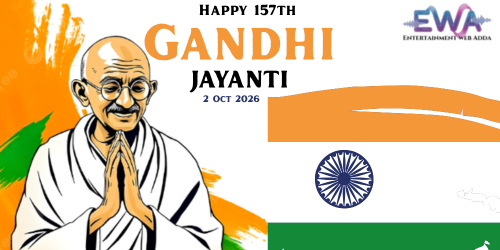
Gandhi Jayanti 2026
Commemorating the 157th Birth Anniversary of Mahatma Gandhi, His Role in India’s Freedom Struggle, and the Global Legacy of Non-Violence
Gandhi Jayanti 2026 marks the 157th birth anniversary of Mohandas Karamchand Gandhi, affectionately revered as the Father of the Nation. Celebrated every year on October 2nd, Gandhi Jayanti is one of India’s three official national holidays (alongside Republic Day and Independence Day). Beyond India’s borders, the day is recognized worldwide by the United Nations as the International Day of Non-Violence.
This significant day is an occasion not only to pay homage to a visionary leader but also to reflect on his core principles—Ahimsa (non-violence), Satyagraha (truth-force), Swaraj (self-rule), and Sarvodaya (welfare for all)—which transformed India’s independence movement into a mass, ethical crusade.
Key Highlights & Overview of Gandhi Jayanti 2026
| Aspect | Details |
|---|---|
| Event | Gandhi Jayanti 2026 (157th Birth Anniversary) |
| Date of Observance | Friday, October 2, 2026 |
| Birth Date & Place | October 2, 1869 | Porbandar, Gujarat |
| Global Recognition | International Day of Non-Violence (Declared by UN in 2007) |
| Key Movements | Champaran Satyagraha, Non-Cooperation, Civil Disobedience (Salt March), Quit India |
| Major Memorial Site | Raj Ghat, New Delhi |
Early Life and Transformation
Born in 1869 in Porbandar, Gujarat, Gandhi was raised under the strong moral and religious influence of his mother, Putlibai, and father, Karamchand Gandhi. After studying law in London and being called to the Bar in 1891, Gandhi traveled to South Africa in 1893 for a legal case.
It was in South Africa that Gandhi encountered severe racial discrimination—famously sparked by his forcible removal from a first-class train compartment in Pietermaritzburg. During his two decades in South Africa, he developed the method of Satyagraha—resisting injustice through truth, moral courage, and non-violent resistance—before returning to India in 1915.
Landmark Movements Led by Mahatma Gandhi
Upon his return to India, Gandhi traveled across the country to understand local grievances and transformed the national movement from an elite political discussion into a mass participation movement:
1. Early Local Satyagrahas (1917–1918)
- Champaran Satyagraha (1917): Supported indigo farmers in Bihar against coercive colonial systems.
- Kheda Satyagraha (1918): Supported Gujarat peasants seeking land revenue relief during a severe crop failure.
- Ahmedabad Mill Strike (1918): Intervened in a labor dispute, successfully negotiating fair wages for textile workers.
2. The Non-Cooperation Movement (1920–1922)
In response to the Rowlatt Act and the brutal Jallianwala Bagh massacre of 1919, Gandhi rallied the nation to boycott British goods, titles, educational institutions, and courts, promoting local weaving (Khadi) and self-reliance.
3. The Civil Disobedience Movement & Dandi March (1930)
Highlighting the unjust tax on a basic necessity, Gandhi led the historic 240-mile Dandi Salt March from Sabarmati Ashram to the coast of Dandi. By making salt illegally, Gandhi sparked nationwide civil disobedience that drew global attention and massive participation, especially from women.
4. The Quit India Movement (1942)
Launched during World War II following the failure of the Cripps Mission, Gandhi issued his decisive call to the nation: “Do or Die”. It became the final major national struggle demanding an immediate end to British colonial rule.
💡 Did You Know? The United Nations General Assembly officially declared October 2nd as the International Day of Non-Violence in June 2007 to spread the message of peace, tolerance, and non-violent conflict resolution worldwide.
Core Principles of Gandhian Thought
- Satyagraha (Insistence on Truth): Holding firmly to truth and confronting injustice without hatred or violence.
- Ahimsa (Non-Violence): Total commitment to non-injury in thought, word, and deed toward all living beings.
- Swaraj (Self-Rule): Political independence combined with moral self-discipline and community responsibility.
- Sarvodaya (Welfare of All): Ensuring that economic and social progress prioritizes the poorest and most marginalized.
- Swadeshi (Local Self-Reliance): Encouraging indigenous industries, home spinning, and local economy.
Modern Legacy & Celebrations
Today, Gandhi Jayanti is celebrated across India through prayer meetings, commemorative events at educational institutions, and community service. Special tributes and multi-faith prayers take place at Raj Ghat, Gandhi’s memorial in Delhi.
In recent years, Gandhi’s emphasis on cleanliness has been revitalized through national civic initiatives like the Swachh Bharat Mission, which was launched on Gandhi Jayanti in 2014 to promote sanitation, hygiene, and community-driven clean-up drives.
Explore More Related Resources
To dive deeper into the history of Mahatma Gandhi and other upcoming cultural celebrations, visit the following authoritative resources:
- Read more about Gandhi Jayanti history, significance, and celebrations on Wikipedia: Gandhi Jayanti.
- Explore upcoming festive dates and cultural insights for October 2026 on Entertainment Web Adda: Navaratri & Vijayadashami 2026.