

Amruteshwar Temple: A 1,200-Year-Old Stone Enigma in Ratanwadi
Hidden away in the rugged Sahyadri ranges of Maharashtra lies Ratanwadi, a village that guards one of India’s most profound architectural secrets. The Amruteshwar Temple isn’t just a place of prayer; it is a 1,200-year-old masterpiece of black basalt that has stood firm against a millennium of monsoons and history.
The Forgotten Legacy of the Shilaharas
The temple’s story begins in the 9th century CE. It was commissioned by the Shilahara dynasty, specifically under the vision of King Jhanjha. History buffs know Jhanjha as the ruler who vowed to build twelve grand Shiva shrines; this one in Ratanwadi is widely considered his most intricate triumph.
Geometry in Stone
Measuring roughly 61 meters by 36 meters, the temple’s layout follows a classic flow: the mandapa (hall), the antarala (vestibule), and finally the garbhagriha (the inner sanctum). But there’s a twist—while almost every ancient Hindu temple greets the rising sun in the east, Amruteshwar faces west.
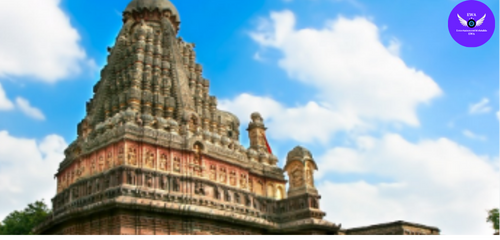
The Shikhara (the main spire) remains the star of the show. It is still remarkably intact, tiered with miniature ornamental carvings that lead your eyes toward the amalaka at the very top. Inside, the pillars are a lesson in evolution; they start as sturdy squares at the base and seamlessly morph into octagonal shafts before reaching the ceiling.
The Mystery in the Sanctum
The deity at Amruteshwar breaks the mold of traditional installations. Here, the Shiva Lingam isn’t raised on a pedestal. Instead, the yoni sits directly over a natural rock cavity that stays filled with water from an underground spring. Three kalasha-shaped stones are stacked above it, creating an elemental, raw connection between the divine and the earth.
The Pushkarani: Reflections of the Past
Just steps away from the main structure is the Pushkarani, a square stepped tank that feels like a quiet sanctuary. With stone steps leading down from three sides, it features small, weathered alcoves housing deities like Ganesha and various avatars of Vishnu. It’s a perfect spot to sit and absorb the stillness of the site.
A Living Monument
Because it captures the peak of Shilahara-era artistry, the Archaeological Survey of India (ASI) has rightfully labeled this a monument of national importance. While it is a quiet retreat most of the year, the temple roars back to life during Mahashivratri, as hundreds of pilgrims arrive to honor a legacy that refuses to fade.
Deepen Your Discovery
Ready to plan your visit or explore the history further? These resources are a great place to start:
History on Wikipedia Architecture Deep-Dive




Pingback: Chitrakoot The Sacred Land of Lord Shree Rama.