
Aravalli Forest : One of the oldest mountain ranges in the world, the Aravalli Range stretches from Delhi in the north through Haryana and Rajasthan to Gujarat in the south. The Aravalli Forest is a portion of this range. These hills are among the planet’s oldest geological structures, dating back more than two billion years. They serve as Northern India’s natural defense, safeguarding the climate, biodiversity, groundwater, environment, and public health.
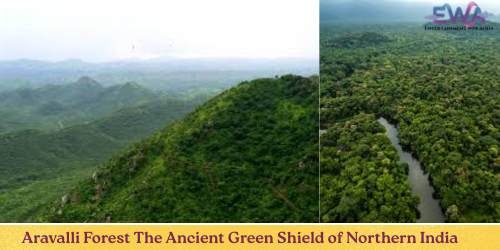
The Importance of the Aravalli Forest
- There is much more to the Aravalli Forest than just a series of verdant hills. It aids in:
- preventing desertification by obstructing the eastward spread of the Thar Desert.
- replenishing groundwater across Rajasthan, Haryana, Delhi-NCR, and Gujarat to sustain wells, rivers, and agriculture.
- controlling the local climate and lowering pollution, heat waves, and dust storms in neighboring cities.
- promoting abundant biodiversity in reserves like the Aravalli hills’ Jaisamand Wildlife Sanctuary and Nahargarh Wildlife Sanctuary, which are home to wild animals and birds.
The forest has spiritual and cultural value as well. Nestled amid these hills are several historic temples and sacred sites; many devotees view places like Sariska and Mount Abu as spiritually significant, fusing nature with tradition. This environment includes temples like the Bhartrihari’s tapasthali, which is said to be the sage Bhartrihari’s meditation spot, and locations associated with the Pandavas from the Mahabharata.
Click here to read about Lav and Kush of Ramayan.
Current Governmental Measures and Debates
In order to standardize protection and mining regulations across states, the Indian Supreme Court approved a unified description of the Aravalli Hills and Range in late 2025. According to this definition, a landform cannot be formally recognized as belonging to the Aravalli Range unless it is at least 100 meters above local relief. A range is defined as two or more of these hills that are within 500 meters of one another.
In an effort to stop illicit and destructive extraction, the Court also put a stop to future mining leases in the area until a thorough management plan for sustainable mining was created.
Nonetheless, this choice provoked heated public discussion and demonstrations. A large portion of the Aravalli landscape, according to critics, could not be legally protected by the 100-meter requirement, leaving lower hills, slopes, and wooded regions open to mining, development, and ecological deterioration. Environmentalists caution that this might erode protections against habitat loss, groundwater depletion, and desertification, resulting in increased dust storms, heatwaves, and worsening air quality in Delhi and the surrounding areas.
Government Protection and Clarification Initiatives
The Union Environment Ministry responded to these worries by stating that the new definition is meant to improve legal clarity without reducing protection. More than 90% of the Aravalli area will be preserved, no new mining licenses will be allowed until the sustainable management plan is complete, and mining in vulnerable and core ecological areas is still completely forbidden, according to officials.





Pingback: Jyothi Yarraji India’s Rising Star in the 100m Hurdles