
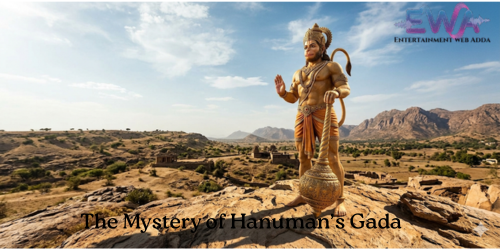
The Mystery of Hanuman’s Gada
Exploring the Divine Origins and the Name of the Mighty Weapon
In the vast tapestry of Hindu mythology, Lord Hanuman stands as the ultimate symbol of strength, devotion, and humility. We often see him depicted as a powerful figure, soaring through the sky or kneeling before Lord Rama. However, the most striking feature of his iconography is the massive golden mace or “Gada” he carries in his left hand. But have you ever wondered where this weapon came from and what it is called?
The Origin: Who Gave the Gada to Hanuman?
The story of Hanuman’s Gada is rooted in his childhood. According to the scriptures, Hanuman was born with immense celestial powers, being the son of Vayu Dev (the Wind God). However, a famous incident occurred when the young Hanuman mistook the rising sun for a ripe fruit and flew into the sky to swallow it.
Lord Indra, the King of Gods, struck the child with his Thunderbolt (Vajra) to protect the universe. This left Hanuman unconscious. Furious, his father Vayu stopped the flow of air throughout the universe. To appease Vayu and revive the child, every primary deity granted Hanuman a unique boon and a divine gift. It was Lord Kubera, the God of Wealth and the Treasurer of the Heavens, who bestowed the Gada upon Hanuman. Along with the weapon, Hanuman was granted the boon that he would never be defeated in battle and that his weapon would be an extension of his own incomparable strength.
What is the Name of Hanuman’s Gada?
Unlike many other divine weapons in Indian mythology—such as Vishnu’s Sudarshana Chakra or Shiva’s Trishul—Hanuman’s mace is most commonly referred to by its descriptive name: Kaumodaki.
While the name Kaumodaki is primarily associated with the Gada of Lord Vishnu, many ancient texts suggest that because Hanuman is an avatar (or partial expansion) of Lord Shiva and a supreme devotee of Lord Vishnu (as Rama), his weapon carries the same divine essence. In various regional folklores, it is simply called the “Atulya Gada” (The Incomparable Mace). The weapon represents the destruction of the ego and the protection of “Dharma” (Righteousness).
Symbolism and Spiritual Meaning
The Gada isn’t just a physical weapon; it symbolizes self-sovereignty, the authority of governance, and the power of concentration. When Hanuman holds the mace, it signifies that he has controlled his senses and redirected his immense energy toward the service of the Divine. For a devotee, the Gada represents the “mace of knowledge” that smashes the obstacles of ignorance and worldly desires.
Learn More and Explore:
To dive deeper into the life and exploits of the Monkey God, you can visit his detailed history here: Lord Hanuman – Wikipedia.
Understanding the context of ancient Indian society and the roles defined within it can also be explored through the social structures of the time: Understanding the Varna System.
In conclusion, Hanuman’s Gada is a gift from the gods, a symbol of protection, and a reminder that true power comes to those who are humble and devoted. Whether you call it Kaumodaki or simply the Maha-Gada, it remains a symbol of hope for millions of devotees worldwide.






Pingback: Lord Hanuman’s Marriage History